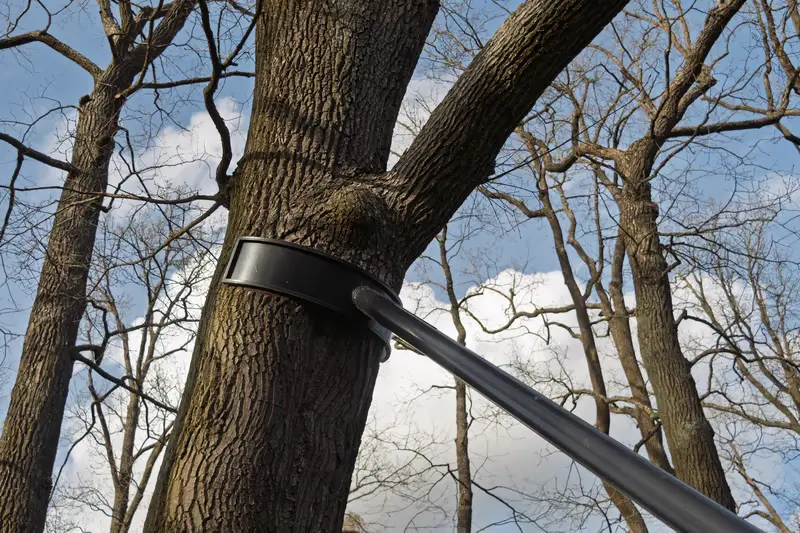
Imagine a mature oak standing in your front yard. It has shaded the house for decades, and its wide branches give the garden much of its character. One afternoon, you notice two large stems growing at a narrow angle from the same point. A deep crack has started to appear where they meet. You worry that the next strong storm could split the tree apart.
Removing the tree might seem like the only safe choice, but there may be another option. An arborist could recommend a support system designed to reduce movement and lower the risk of failure. Understanding tree cabling benefits helps property owners decide when this approach makes sense and when a damaged tree needs a different solution.
Tree cabling is not a repair that makes a weak tree new again. It is a supplemental support technique that helps manage structural weaknesses. When an experienced arborist designs and installs the system correctly, it can help preserve valuable trees while reducing certain safety risks.
What Is Tree Cabling and How Does It Work?
Tree cabling is an arboricultural technique that connects selected branches or stems with a flexible support cable. The system helps limit excessive movement between weak or poorly attached sections. It is commonly considered when a tree has multiple leaders, heavy limbs, narrow branch unions, or structural defects that increase the chance of failure.
The cable is usually installed high in the canopy, between the sections that need support. Its position, material, and strength depend on the tree’s structure and the purpose of the installation. Some systems use steel cable, while others use synthetic materials designed for tree support.
A cable does not hold every branch completely still. Trees need some natural movement to develop and respond to their environment. The goal is to reduce excessive movement during wind or heavy loading, not to turn the canopy into a rigid structure.
This is one of the main tree cabling benefits. A properly planned system can provide additional support while allowing the tree to continue growing. However, the tree must be assessed first because cabling cannot compensate for every type of structural failure.
What Are the Main Tree Cabling Benefits?
The value of cabling depends on the tree’s condition and location. A mature tree with a weak branch union above a driveway presents a different situation from a healthy tree growing in an open field. An arborist considers both the structural problem and the consequences if a branch fails.
Improved Support for Weak Branch Unions
Some trees develop two or more major stems from a single point. These are often called codominant stems. When the stems grow close together, their attachment may be weaker than a branch connection with a well-developed branch collar. Included bark can also form between them, reducing the strength of the union.
As the stems grow heavier, wind and snow can place additional stress on the attachment. A support cable connects selected stems and helps limit their movement relative to each other. This can reduce the likelihood of the union separating under certain loading conditions.
For example, a mature maple beside a family home may have two large leaders with a narrow attachment. If the trunk and root system remain sound, an arborist may consider cabling as part of a risk management plan. The decision depends on the amount of included bark, existing cracks, decay, and the weight carried by each leader.
Reduced Risk of Branch or Stem Failure
A large branch can cause serious damage when it breaks above a roof, parking area, walkway, or outdoor seating space. Cabling may reduce the risk of failure in selected branches by limiting excessive movement and helping distribute loads through the support system.
This does not mean a cabled branch cannot break. Severe storms, hidden decay, poor installation, and changes in the tree’s condition can still lead to failure. The system is an added layer of support, not a guarantee against falling limbs.
One of the practical tree cabling benefits is the opportunity to manage a specific weakness instead of automatically removing an entire tree. An arborist may combine cabling with selective pruning to reduce excess weight and improve the canopy’s structure.
Preservation of Mature and Valuable Trees
Large trees provide shade, privacy, wildlife habitat, and visual character. A mature tree can take many years to replace, so retaining a structurally manageable specimen may be worthwhile.
Cabling can sometimes help extend the useful life of a tree that has a localized weakness but remains healthy enough to support continued growth. This can be particularly valuable in established gardens, historic landscapes, and properties where a large tree contributes significantly to the setting.
However, preservation should not come at the expense of safety. If the main trunk is extensively decayed, roots are failing, or the tree is unstable as a whole, cabling may not be appropriate. A qualified arborist must assess whether the tree is a suitable candidate.
Which Trees May Benefit From Cabling?
Not every tree needs a support system. Cabling is generally considered when a specific structural condition creates an increased risk of failure and the tree has enough sound wood to support the hardware.
Trees with codominant stems are common candidates for assessment. The same applies to trees with long, heavy horizontal branches, narrow branch attachments, or a history of storm damage. Some mature trees develop asymmetrical canopies that place uneven loads on major limbs.
Species and growth habits matter. Certain trees naturally develop multiple stems or broad crowns. Others may be more prone to weak branch unions because of their growth patterns. An arborist should consider the species, age, health, and local weather conditions before recommending support.
The location also influences the decision. A weak branch over an empty wooded area may present a lower risk than a similar branch above a busy entrance. Cabling is most useful when the structural concern and the potential consequences of failure have both been evaluated.
What Types of Tree Cabling Systems Are Available?
The right system depends on the tree’s structure, the amount of movement that needs to be controlled, and the support objective. Professional arborists select the system after inspecting the tree rather than using one standard arrangement for every job.
Static Cabling Systems
Static systems generally use steel cables or similar materials to provide support with limited stretch. They are designed to restrict movement between connected stems or branches. The arborist selects suitable hardware, attachment points, and cable tension according to the tree’s condition.
These systems may be considered when an existing structural defect needs a more controlled form of support. Installation requires careful attention to the condition of the wood and the placement of anchors. Hardware should not be installed in significantly decayed areas because the attachment itself needs sound supporting material.
Dynamic Cabling Systems
Dynamic systems use flexible synthetic materials that allow a degree of movement. They are designed to support selected branches or stems while permitting more natural motion. This can be useful in situations where limiting movement too rigidly would not suit the tree’s structure.
The material must be suitable for outdoor exposure and the expected loads. Ultraviolet resistance, strength, connection design, and correct installation all matter. Dynamic systems also need inspection because ropes and connectors can wear, shift, or deteriorate over time.
Direct and Triangular Cable Arrangements
A direct system connects two selected parts of a tree with a single cable. It may be suitable when one branch or stem needs support from another. A triangular arrangement connects three tree parts and can provide support in more complex structures.
The Tree Care Industry Association describes several cabling configurations under ANSI A300 supplemental support guidance, including direct, triangular, box, and hub-and-spoke systems. Each has a different purpose, and more complicated arrangements are not automatically better. The design should match the tree’s actual structural needs.
How Does Tree Cabling Improve Property Safety?
A large branch does not need to fall completely to create a hazard. It may crack, hang over a roof, block an entrance, or damage a parked vehicle. Reducing excessive movement in a vulnerable part of the canopy can help manage some of these risks.
For a property owner, the benefit is often practical. Consider a mature tree beside a driveway where family members park their vehicles. An arborist identifies a weak union between two main stems. After assessing the trunk, roots, and canopy, the arborist may recommend a support system along with selective pruning. The aim is to reduce the chance of a major split and make the area safer to use.
Cabling can also help protect valuable landscape features. A tree near a patio, garden path, or public seating area may be worth preserving if its defects can be managed. Still, the level of risk must remain acceptable after treatment.
Tree cabling benefits should never be interpreted as permission to ignore a dangerous tree. If a tree has a major crack, extensive decay, or signs of imminent failure, keep people away and arrange an urgent professional assessment. Cabling is not an emergency fix for every unstable tree.
Can Tree Cabling Extend a Tree’s Lifespan?
Cabling may help extend the useful life of a suitable tree by reducing stress on selected branches or stems. When a structural weakness is limited and the rest of the tree is healthy, additional support may allow the tree to remain in the landscape longer than it otherwise could.
However, cabling does not stop aging, cure decay, or restore damaged wood. A tree continues to respond to wind, rainfall, growth, disease, and changes in soil conditions. Its structure may become stronger in some areas and weaker in others as time passes.
This is why lifespan should be discussed carefully. A support system may help preserve a tree, but it cannot promise a specific number of additional years. The arborist should explain what the system is expected to achieve, what risks remain, and what future maintenance will involve.
The U.S. Forest Service’s urban tree risk guidance also emphasizes assessing the whole tree before cabling or bracing. Root condition, decay, species characteristics, installation cost, and future maintenance all affect whether support is a sensible investment.
How Is a Tree Cabling System Installed?
Professional installation begins with a detailed inspection. The arborist examines the trunk, major branches, attachment points, visible cracks, decay, root condition, and overall canopy balance. The tree’s location and the targets beneath it are also considered.
The next step is to define the objective. The system may be intended to limit movement between codominant stems, support an overextended branch, or reduce the chance of a specific structural failure. The arborist then selects the cable type, hardware, configuration, and installation positions.
Before installation, necessary pruning may be carried out to reduce excessive weight or remove defective branches. The support hardware is then fitted at the planned attachment points. The exact method depends on the system and the condition of the tree.
Professional installation should follow recognized arboricultural practices. ANSI A300 Part 3 addresses supplemental support systems, including cabling, bracing, guying, and related hardware selection. The Tree Care Industry Association identifies installation and maintenance as key parts of this standard.
Does Tree Cabling Require Regular Maintenance?
Yes. A support system is not a one-time installation that can be forgotten. Trees grow, branches change position, and materials experience weather exposure. A cable that was suitable several years ago may need adjustment, replacement, or a new inspection as the tree develops.
An arborist should establish an inspection schedule based on the tree’s condition, support system, and surrounding risks. The owner should also arrange an assessment after major storms or when visible changes appear. Look for damaged hardware, unusual movement, broken branches, or changes around the attachment points, but do not climb the tree to inspect the system yourself.
The Tree Care Industry Association specifically advises periodic inspections of supplemental support systems by an arborist. Responsibility for arranging these inspections rests with the tree owner.
Maintenance records are useful. Keep the installation date, system type, inspection findings, and any repairs together. This gives future arborists a clearer picture of the tree’s history and helps them decide whether the existing arrangement remains suitable.
When Is Tree Cabling Not the Right Solution?
Cabling is not suitable for every damaged tree. A tree with extensive trunk decay, severe root failure, or major structural instability may not have enough sound wood to hold the support system safely. Installing cables in weak or decayed attachment areas can create a false sense of security.
It may also be unsuitable when the tree’s overall condition is declining rapidly. If the canopy is dying, the main trunk is compromised, or the root plate is moving, removal may be the safer option. The arborist should explain why support is unlikely to manage the risk.
Sometimes pruning is enough. A heavy branch with excessive end weight may be made safer through careful reduction, provided the cuts are appropriate for the species and tree structure. In other cases, a brace, prop, or another support method may be more suitable than cabling alone.
The best recommendation considers the tree as a whole, not just the visible crack. A responsible arborist will discuss the benefits, limitations, remaining risks, and likely maintenance costs before work begins.
How Do You Choose a Qualified Arborist for Tree Cabling?
Choose an arborist with specific experience in structural assessment and supplemental support systems. General tree trimming experience is useful, but cabling requires knowledge of tree mechanics, hardware, installation methods, and long-term inspection.
Ask how the arborist will assess the tree and what problem the proposed system is intended to address. A good explanation should identify the weak union or branch, describe the expected effect of the support, and clarify what risks will remain afterward.
Request details about the cable material, hardware, installation approach, and inspection schedule. Ask whether the work follows current ANSI A300 guidance and applicable safety practices. You can also check professional qualifications, insurance, and references.
Be cautious of anyone who promises that cabling will make a tree completely safe or permanently prevent failure. No support system can remove every risk. A trustworthy professional explains realistic outcomes and may recommend removal if the tree cannot be supported safely.
Conclusion
Tree cabling can help manage structural weaknesses in selected mature trees. It may reduce excessive branch movement, support vulnerable unions, and preserve trees that still have sound structure and a useful future. These advantages make it a valuable option in some residential and commercial landscapes.
The decision should always begin with a professional assessment. The tree’s roots, trunk, canopy, species, and surroundings all influence whether support is appropriate. Correct installation and regular inspections are just as important as choosing the right system. When used for the right reasons, tree cabling benefits can include improved risk management and a longer period of safe enjoyment of a valuable tree.
Frequently Asked Questions
1. What are the main benefits of tree cabling?
Tree cabling can provide extra support to weak branch unions, reduce excessive movement between major stems, and lower the risk of certain failures. It may also help preserve mature trees that have manageable structural defects. However, it does not eliminate every hazard or replace regular inspections by a qualified arborist.
2. How long does tree cabling last?
There is no fixed lifespan for every cabling system. Durability depends on the materials, installation quality, tree growth, weather exposure, and maintenance. Steel and synthetic systems have different inspection needs. An arborist should check the hardware periodically and recommend repairs or replacement when the tree or system changes.
3. Is tree cabling better than removing a damaged tree?
It can be a suitable alternative when the tree is healthy enough to retain and the structural weakness can be managed safely. If the trunk, roots, or major stems are severely compromised, removal may be the responsible choice. A professional risk assessment helps determine which option is appropriate.